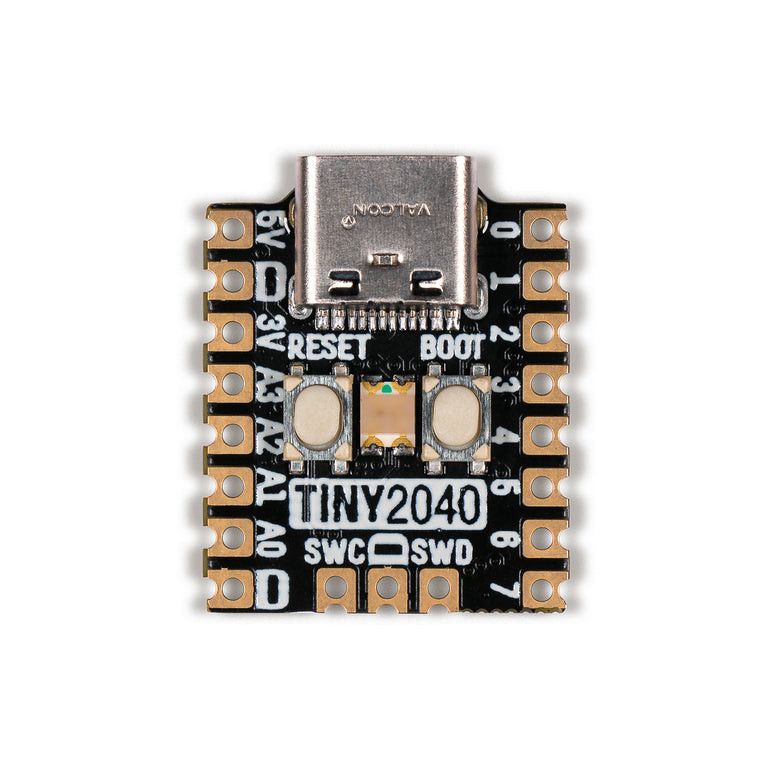
Pimoroni PIM593 - Tiny 2040, 2MB version. Stamp-sized RP2040 development board with USB-C connector. Perfect for embedding in portable projects, wearable products and items.
A postage-stamp sized RP2040 development board with a USB-C connector, ideal for portable projects, wearables and embedding into products.
While Pimoroni loves the Raspberry Pi Pico, they also wanted something smaller with more flash. Introducing the Tiny 2040 — a tiny powerhouse capable of really ambitious projects.
The Tiny 2040 is powered and programmable over USB-C, and features an 8MB QSPI (XiP) flash stick (a budget-friendly 2MB version is also available). The board is designed with castellated pads so it can be soldered directly to a PCB (or you can fit header pins to plug it into a breadboard or attach things directly with wires). Pimoroni have also managed to fit a programmable RGB LED, a reset button and some clever circuitry that lets you use the boot button as a user-controlled switch.
It is compatible with firmware built for the Raspberry Pi Pico, but offers fewer pins due to its size. You can even use MicroPython on it!
Due to popular demand we also now have Tiny 2040 boards with downward-facing header pins that the pirates have lovingly pre-soldered for you.
Features
Powered by RP2040
ARM Cortex M0+ running at up to 133 MHz.
264kB of SRAM
USB-C connector for power, programming and data
2MB or 8MB QSPI flash with XiP support.
User-controllable RGB LED
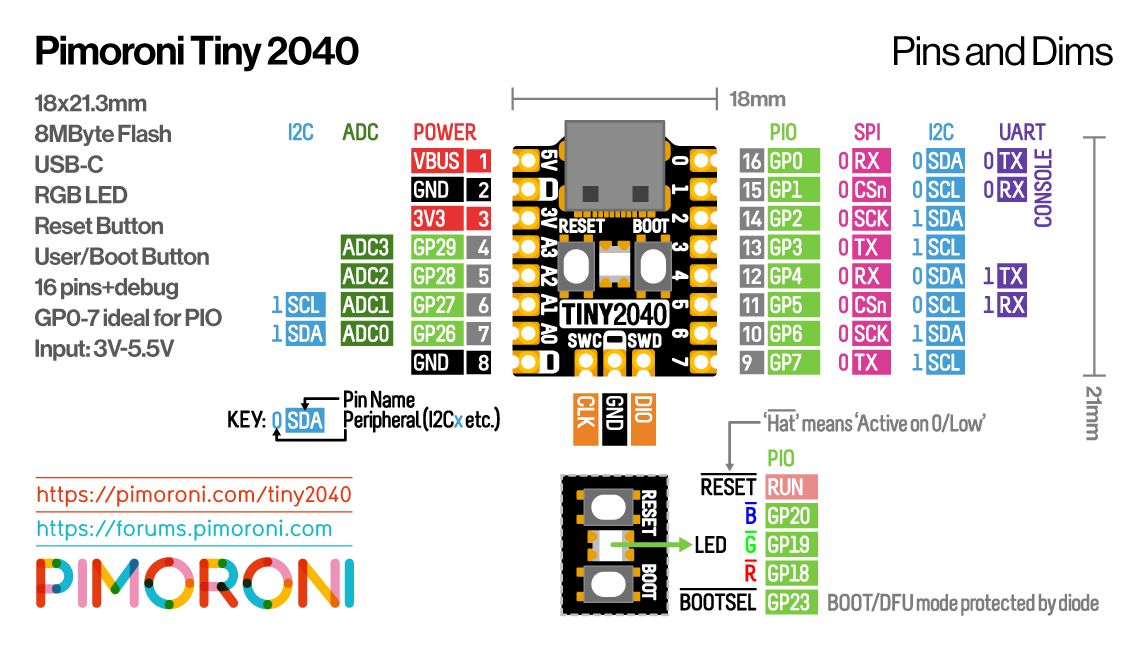
Twelve IO pins (including four 12-bit ADC channels)
Switch for a basic input (also acts as DFU selector during boot).
Built-in 3V3 regulator (maximum regulator output current 300mA).
Input voltage range 3V - 5.5V
Dimensions: approximately 22.9 x 18.2 x 6 mm (L x W x H, including the USB-C port).
Tiny 2040 is firmware agnostic! You can program it in C/C++ or MicroPython the same way as a Raspberry Pi Pico, although you need to bear in mind it has fewer pins. The RP2040 getting started page contains (lots of) information on how to do this (and download links for the firmware/SDK).
You can also use CircuitPython on your Tiny 2040! CircuitPython is an easy-to-use, established ecosystem with lots of example code and drivers for interfacing with different hardware.
The RGB LED is connected to GP18-GP20 and is active low (so the on/off behavior is inverted compared to the Raspberry Pi Pico LED). You can PWM the pins to dim the LED — see Tonygo2's MicroPython example.
About the RP2040
Raspberry Pi's RP2040 microcontroller is a dual-core ARM Cortex M0+ running at 133 MHz. It includes 264kB of SRAM, 30 multi-function GPIO pins (including a four-channel 12-bit ADC), a bunch of standard peripherals (I2C, SPI, UART, PWM, clocks, etc.) and USB support.
One of the most exciting features of the RP2040 is its programmable IOs, which let you run custom programs that can handle GPIO pins and move data between peripherals — they can offload tasks that require high data throughput or precise timing that would traditionally demand a lot of heavy lifting from the CPU.