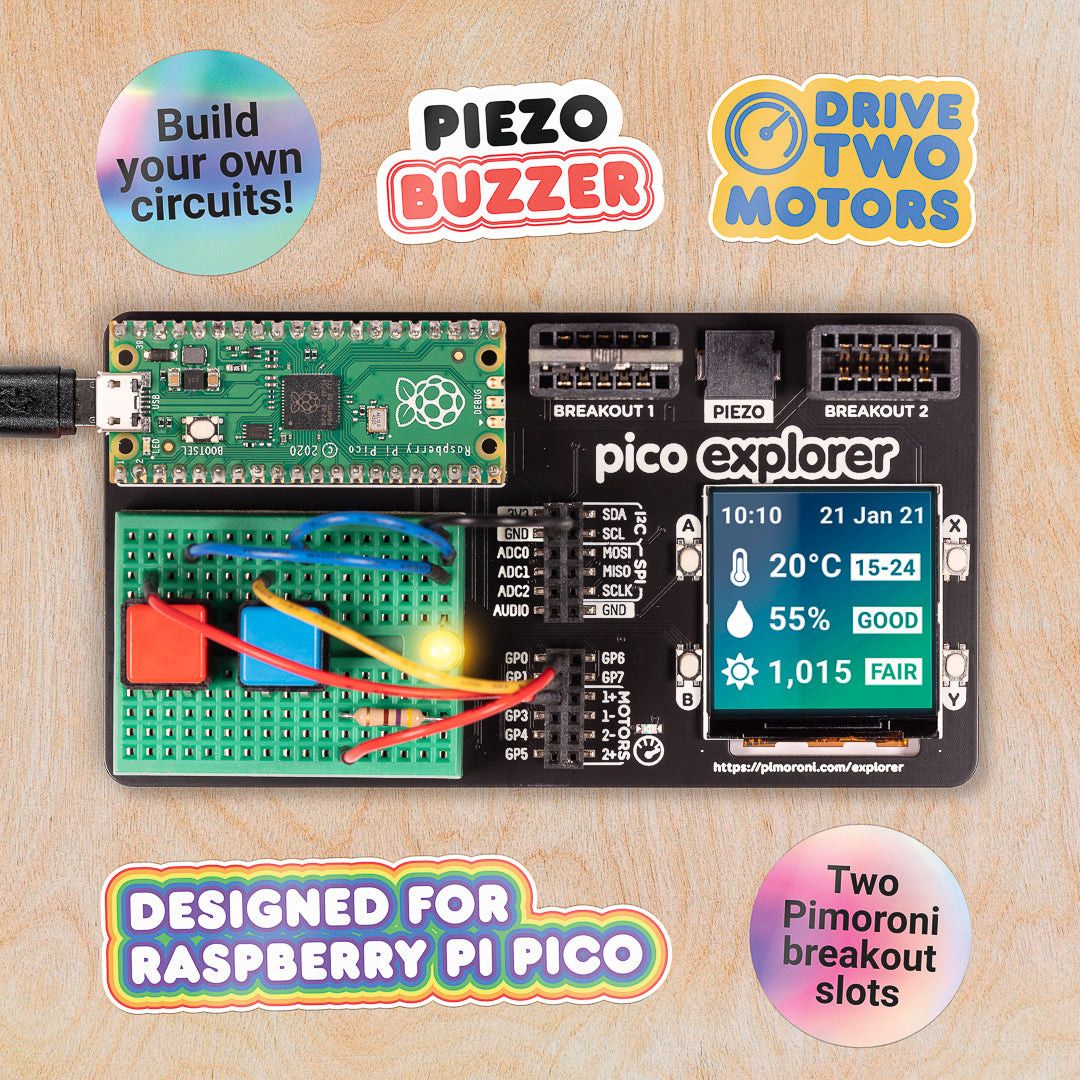
Pimoroni PIM550 - Explorer Base is a great starting point for anyone who wants to tinker with the Pico. The display is easy to use, the built-in motor drivers and GPIO are user-friendly, and the I2C ports are a welcome addition that makes using modules easier.
Turn your Raspberry Pi Pico into an electronic adventure playground full of physical computing treats like an LCD display, motor drivers, a mini breadboard and much more!
With the Pico Explorer you can play with circuits, build scientific experiments, prototype small robots and inventions, and above all figure out how everything works.
Pimoroni included essential maker bits such as a mini breadboard, motor drivers, ADC outputs, a built-in speaker, general purpose inputs/outputs, switches and two Breakout Garden slots* so you can add a couple from our wide Pimoroni Breakout range.
Pimoroni also managed to fit a vibrant 240x240 IPS LCD display with four tactile buttons, so you can easily monitor and control your project. Everything is wrapped up on a nice, sturdy baseboard whose pleasantly compact footprint doesn’t involve nearly as many wires as if you tried a traditional breadboard setup. Boo wires, yay Pico Explorer!
With Pimoroni’s comprehensive MicroPython and C++ libraries you can control all parts of the board like a digital maestro. It’s great for beginners, advanced users, and those who sit awkwardly somewhere in the middle and can’t be put in a simple demographic bucket — we know who you are.
Pimoroni really crams as much functionality as possible onto this board — many of us were lucky enough to have a small all-in-one electronics kit as kids, so we jumped at the chance to make a modern version.
Raspberry Pi Pico and breadboardable components such as LEDs, jumper wires and extra buttons are not included.
Your Pico’s male header pins must be soldered (pins facing down) so it can be attached to our add-on board.
Features
Pico Explorer Base
Piezo speaker
1.54" IPS LCD display (240 x 240)
Four user-accessible switches
Two H-bridge motor drivers (with over-current indicator LEDs)
Easy-to-use GPIO and ADC header pins
Two Breakout Garden I2C connectors*
Mini breadboard
Rubber feet
Compatible with Raspberry Pi Pico/Pico W.
No soldering required (provided your Pico has pre-fitted header pins).
Dimensions: approx. 117mm x 63mm x 20mm (L x W x H, assembled).
The landing area on the Pico Explorer Base shows which way the Pico should be connected — just align the USB port with the PCB markings.
The easiest way to get going is to download and copy Pimoroni’s custom MicroPython uf2 to your Pico; it includes all the libraries you need to use our add-ons. The linked beginner-friendly tutorial below shows how to get going with the pirate-branded MicroPython.