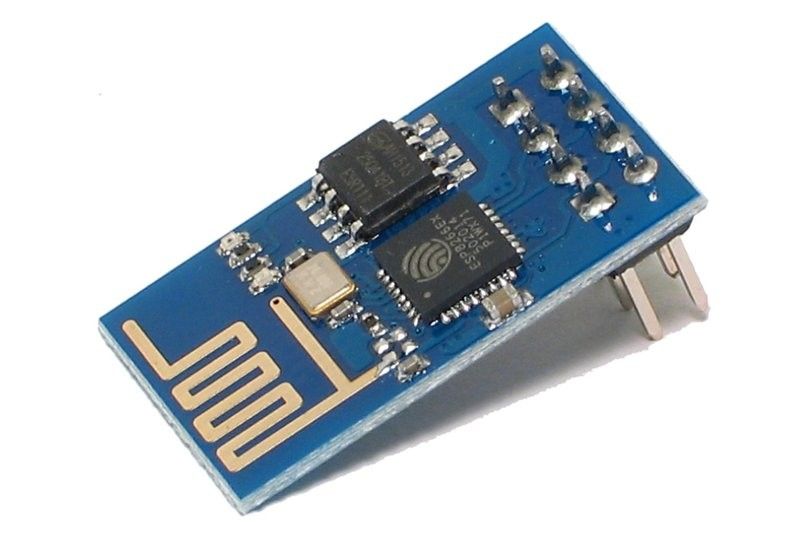
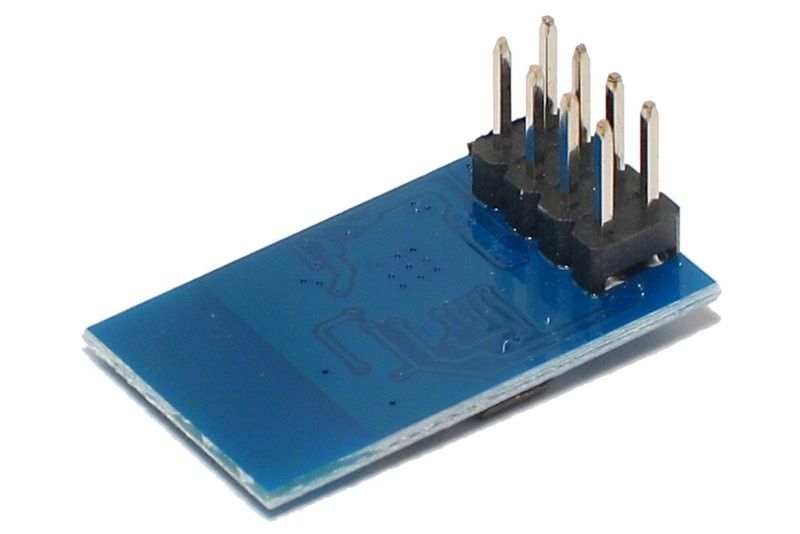
Popular module with its own antenna. Supports TCP protocol directly. With this you can, for example, connect an Arduino to a Wi-Fi network or obtain sensor data over HTTP. Configuration and data transfer are done with simple AT commands. Based on the ESP8266EX SoC. The board has an SPI FLASH 8Mb (= 1MByte) memory chip cFeon Q80B-104HIP. The board's firmware can also be updated and functionality changed (NodeMCU).
- two GPIO pins
- operating voltage: 3,3VDC
- current requirement for stable operation approximately 250mA
- signalling at 3,3V voltage levels
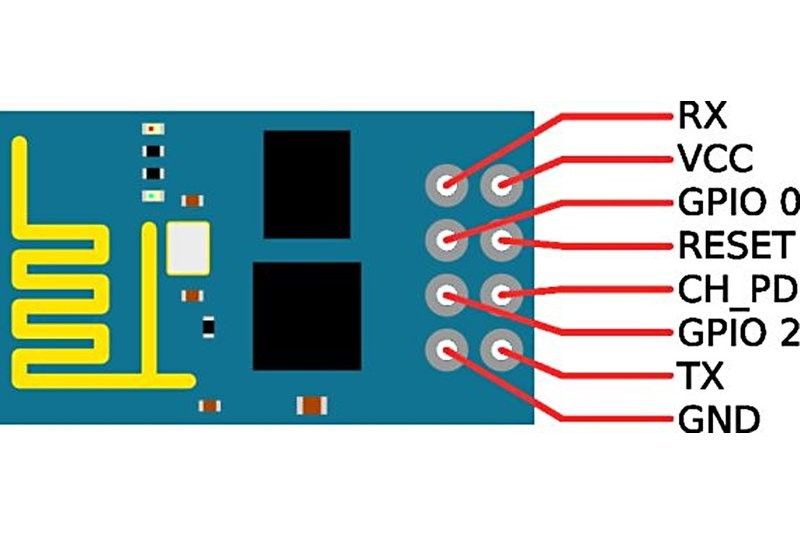
- 2x4 pin header with inch pitch
- can operate in Wi-Fi as host, client or host+client modes (also DHCP server)
- tips:
- remember to connect RST -> VCC
- remember to connect CH_PD -> VCC with pull-up resistor (e.g. 3k3)
- serial port settings 115200, 8N1 and line ending CR+LF
For this unit the command AT+GMR (Print firmware version) returns:
AT version:0.21.0.0 SDK version:0.9.5
By default it offers a Wi-Fi network named: AI-THINKER_A54B8A
AT+CWSAP? +CWSAP:"AI-THINKER_A54B8A","",1,0
This serial WiFi transceiver module is based on ESP8266 SoC.. ESP8266 is a highly integrated chip that has Integrated TCP/ IP protocol stack. It offers a complete and self-contained Wi-Fi networking solution, allowing it to either host the application or to offload all Wi-Fi networking functions from another application processor.
Besides, ESP8266 has powerful on-board processing and storage capabilities that allow it to be integrated with the sensors and other application specific devices through its GPIOs with minimal development up-front and minimal loading during runtime. Its high degree of on-chip integration allows for minimal external circuitry, and the entire solution, including front-end module, is designed to occupy minimal PCB area.
Specification
- 802.11 b/g/n
- Wi-Fi Direct (P2P), soft-AP
- Integrated TCP/IP protocol stack
- Integrated TR switch, balun, LNA, power amplifier and matching network
- Integrated PLLs, regulators, DCXO and power management units
- +19.5dBm output power in 802.11b mode
- Power down leakage current of <10uA
- Integrated low power 32-bit CPU could be used as application processor
- SDIO 1.1/2.0, SPI, UART
- STBC, 1×1 MIMO, 2×1 MIMO
- A-MPDU & A-MSDU aggregation & 0.4ms guard interval
- Wake up and transmit packets in < 2ms
- Standby power consumption of < 1.0mW (DTIM3)
Features
- SDIO 2.0, SPI, UART
- 32-pin QFN package
- Integrated RF switch, balun, 24dBm PA, DCXO, and PMU
- Integrated RISC processor, on-chip memory and external memory interfaces
- Integrated MAC/baseband processors
- Quality of Service management
- I2S interface for high fidelity audio applications
- On-chip low-dropout linear regulators for all internal supplies
- Proprietary spurious-free clock generation architecture
- Integrated WEP, TKIP, AES, and WAPI engines
Usage