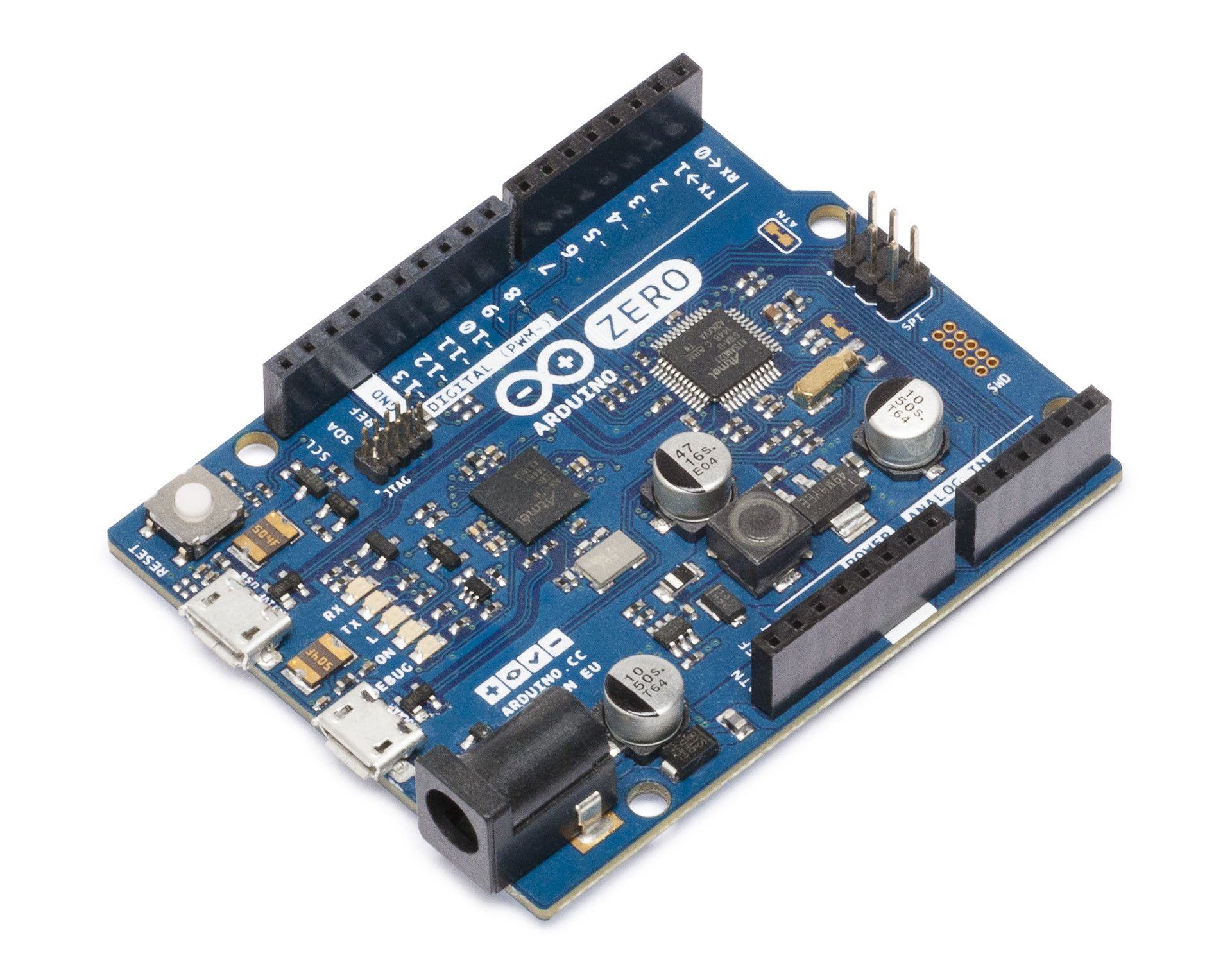
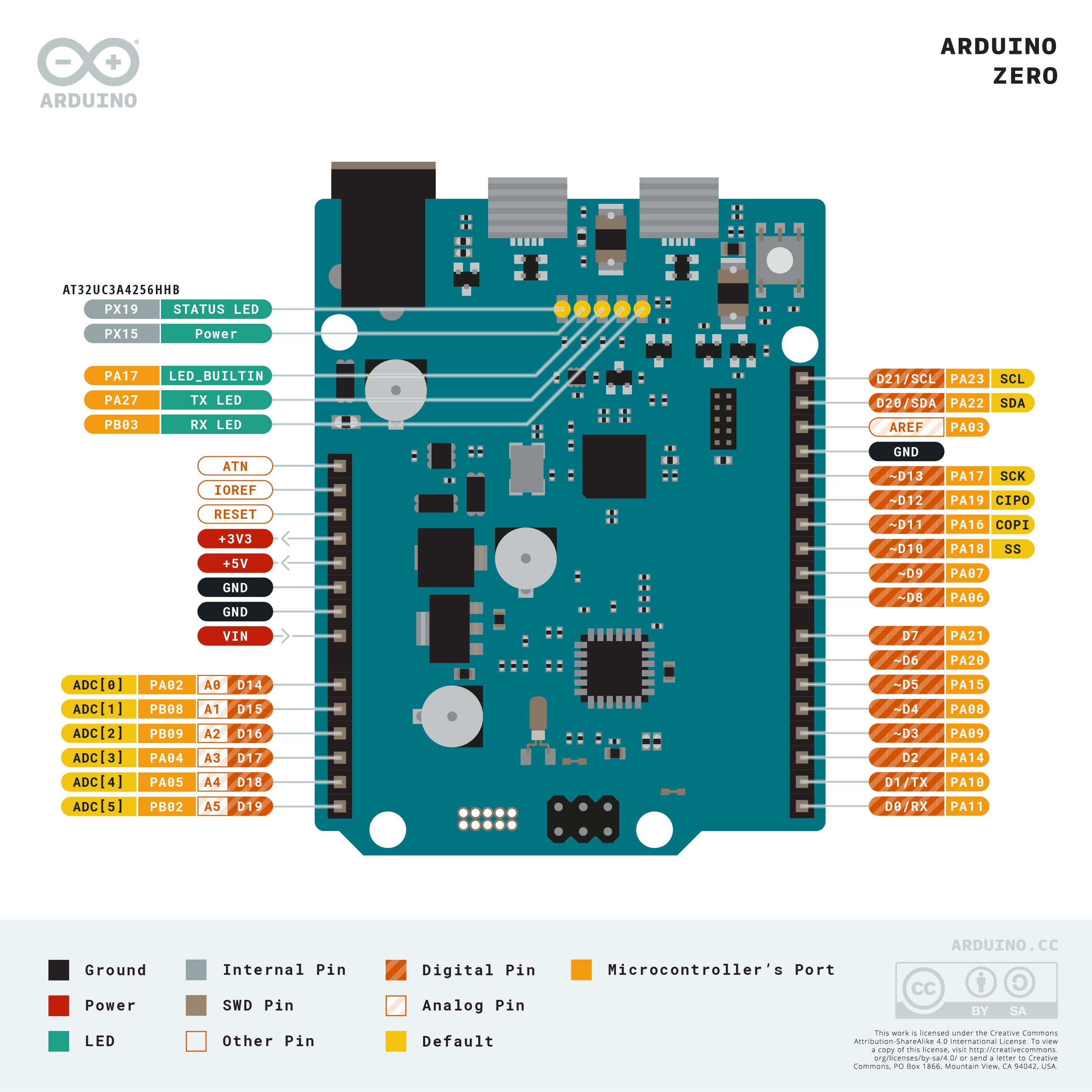
Zero is a simple and powerful 32-bit expansion for the platform established by the UNO. Zero expands the family by offering improved performance, enabling a variety of project possibilities for devices and serving as an excellent teaching tool for learning 32-bit application development. Zero applications range from smart IoT devices and consumer electronics to high-tech automation and robotics. The board is based on Atmel's SAMD21 MCU, which features a 32-bit ARM® Cortex® M0+ core. One of its key features is Atmel's built-in Embedded Debugger (EDBG), which provides a full debug interface without additional hardware, greatly simplifying software debugging. EDBG also supports a virtual COM port that can be used for device communication and bootloader programming.
Warning: Unlike most Arduino boards, the Zero operates at 3.3V. The maximum tolerated voltage on I/O pins is 3.3V. Applying more than 3.3V to any I/O pin may damage the board.
The board includes everything needed to support the microcontroller; simply connect it to a computer with a micro-USB cable or power it with an AC-DC adapter or a battery. Zero is compatible with all shields that operate at 3.3V and follow the 1.0 Arduino pinout.
Specifications
| Microcontroller |
ATSAMD21G18, 32-Bit ARM® Cortex® M0+ |
| Operating Voltage |
3.3V |
| Digital I/O Pins |
20 |
| PWM Pins |
3, 4, 5, 6, 8, 9, 10, 11, 12, 13 |
| UART |
2 (Native and Programming) |
| Analog Input Pins |
6, 12-bit ADC channels |
| Analog Output Pins |
1, 10-bit DAC |
| External Interrupts |
All pins except pin 4 |
| DC Current per I/O Pin |
7 mA |
| Flash Memory |
256 KB |
| SRAM |
32 KB |
| EEPROM |
None. See documentation |
| LED_BUILTIN |
13 |
| Clock Speed |
48 MHz |
| Length |
68 mm |
| Width |
53 mm |
| Weight |
12 gr. |
Links